



(c)2012 egyptwithomarsharif.com . All Copy Rights Reserved.
Designed & Hosted by:


Karnak Temples
The Temple of Karnak is actually three main temples, smaller enclosed temples, and several outer temples. This vast complex was built and enlarged over a thirteen hundred year period. The three main temples of Mut, Monthu and Amun are enclosed by enormous brick walls. The Open Air Museum is located to the north of the first courtyard, across from the Sacred Lake. The main complex, The Temple of Amun, is situated in the center of the entire complex.
The Temple of Monthu is to the north of the Temple of Amun, while the Temple of Mute is to the south. The temple of Karnak was known as Ipet-isut (Most select of places) by the ancient Egyptians. It is a city of temples built over 2000 years to the Theben triad of Amon, Mute and Khonsu. The construction of Karnak Temple began in the Middle Kingdom and was completed during the New Kingdom, some 1,600 years later. Every successive king of this era added to the temple, which covers two hectares (five acres) of land.
The area of the sacred enclosure of Amon alone is 61 acres and would hold ten average European cathedrals. The great temple at the heart of Karnak is so big. The Hypostyle hall at 54,000 square feet with its 134 columns is still the largest room of any religious building in the world. In addition to the main sanctuary there are several smaller temples and a vast sacred lake. It is a complicated site with four courtyards, ten pylons, a sacred lake and many buildings.
Karnak is the home of the god Amon who was an insignificant local god until the 12th dynasty when Thebes became the capital of Egypt. He was represented in his original state as a goose and later as a ram, at the height of his power he was shown as a human with a head dress of feathers - all that remained of the goose.
In ancient times wars were not fought between countries but were considered as contests between gods. This is how Amon, with the help of Thutmose III and various other New Kingdom kings, rose to become the first supreme god of the known world and was hailed as God of gods. Little is know of him, unlike most other gods he has no legends or miracles to impress his worshippers and seems to be closer to an abstract idea of a godhead. His followers came from all the strata of society.
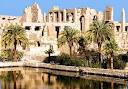
All Egyptian temples had a sacred lake, Karnak's is the largest. It was used during festivals when images of the gods would sail across it on golden barges. Karnak was also the home of a flock of geese dedicated to Amon.
Many of the main roads which lead to the temples of Thebes
(Luxor) used to be continuously lined with sphinxes. Those which flank the entrance of the First Pylon of Karnak combine the body of a lion with the head of a ram. The ram was a symbol of the god Amun for whom the temple was built. Each sphinx protects, between its forelegs, a standing statue of the king--originally Ramesses II (c.1279-1213 B.C.).
An avenue of sphinxes with curly-horned rams' heads leads to the entrance to the first pylon. The sphinxes represent a form of the sun god, Amun-Re. Between their paws is a small figure of Rameses II, who won the famous Battle of Qadesh against the Hittites in Syria (1274 B.C.)
The Temple of Amun
This is the main temple within the Karnak Complex and was dedicated to Amun the god of Thebes. On being combined with the sun god Re to form Amun-Re he would become the central god of the New Kingdom (1540 - 1069 BC).
The first pylon was started in the XXV Dynasty but never finished, an attempt to emulate the grandeur of earlier times failed in all ways apart from size. At 113 metres wide and 43 metres high it is the largest here at Karnak and dwarfs its equivalent at Luxor.
The second pylon was the work of Horemheb and leads into the immense Hypostyle Hall. This was started during the reign of Ramses I the founder of the XIV Dynasty. The hall was finally finished under his grandson: Ramses II.
The hall would have been about 25 metres high and it is hard to take in the idea as you walk between these huge papyrus columns that they originally held up a roof. I haven't tried but they reckon it would take six tourists to be able to link hands around the base of the central columns.
If you look around the walls of the hall you will see two distinctly different sets of carvings. Those in the northern half were made during the reign of Seti I and show him in battles throughout what we now call the Middle East.
Those in the southern of the hall are of Ramses II and you can see how that they have been cut differently. Those of Seti are carved so that the area around the subject is cut away leaving the subject. This meant of course that later rulers could simply chisel out the subject.
In the center of this first court are the ruins of the kiosk of Taharqa (690-664 B.C.), one column (middle ground, right) of which is complete. Beyond the kiosk before the Second Pylon are two standing statues of Ramesses II (c.1279-1213 B.C.). After the Second Pylon, the columns of the Great Hypostyle Hall can be seen.
The Hypostyle Hall is found after passing through the Second Pylon. The hall is considered to be one of the world's greatest architectural masterpieces. Construction began during Ramesses I's reign. He was the king who founded the Nineteenth Dynasty and was king for only one year. The work continued under Seti I (1306 - 1290 BC). Seti I also built the Temple of Abydos and many other temples. The hall was completed by Seti's son, Ramesses II. The effects that are produced inside the hall are much different than they were originally. The huge architraves are not above the capitals that tower above. Towards to center of the hall several architraves and windows that have stone latticework still remain. This small area can give you an idea of the builders' intent for the lighting effects. Some imagination is required here to appreciate what it must have looked like. The walls, ceilings and columns are painted with the natural earth tones. The light that was allowed in originally kept most of the hall in shadows. The hall ceiling was 82 feet high and was supported by 12 papyrus columns. The columns are made of sandstone and set in two rows of six. Each row is flanked on either side by 7 rows of columns that are 42 feet (12.8m) high. Each row has 9 columns, however the inner rows have 7 columns. The reliefs throughout the hall contain symbolism of Creation. The reliefs in the northern half are from the time period of Seti I and are obviously better done than those done by his son Ramesses II, which are in the southern half. Ramesses II's reliefs are cut much deeper than those of Seti's. This gives a much more dramatic light and shadow effect.
The outer walls of the Hypostyle Hall are covered with scenes of battle. Again, Seti I is to the north and Ramesses II is to the south. The scenes have long since lost their color that was painted and the outlines of the scenes have been blurred by the centuries of wind and sun. It is unsure whether the scenes of battle are based on historical fact or of ritual significance. It is thought that when the battle details are very precise, real events are most likely involved. Seti's battles take place in Lebanon, southern Palestine and Syria. The southern walls of Ramesses II have hieroglyphic texts which actually record details of the Hittite king and Ramesses II signing a peace treaty in the twenty-first year of Ramesses reign. This is the first evidence found for a formal diplomatic agreement and is certainly historical.
The Transverse Hall lies beyond the rear wall of the Hypostyle Hall. The wall is mostly ruined. With the Transverse Hall is a partially reconstructed Third Pylon of Amenhotep (Amenophis) III. The Transverse Hall has remains of the earliest sections of the Karnak complex that are still in existence.
Beyond the Third Pylon and in the Central Court of Karnak Temple is the Obelisk of Thutmose I (c.1493-1479 B.C.). This is the last of four obelisks which originally stood in front of the Fourth Pylon, which, in the time of Thutmose I, was the entrance into Karnak Temple. The obelisk is 71 feet/21.7 meters in height, sits on a base 6 feet/1.8 meters square, and weighs about 143 tons. Each side of the obelisk has three vertical lines of inscription, the central one being a dedication by Thutmose I.
Leaving the hypostyle hall through the third pylon you come to a narrow court where there once stood several obelisks. One of the obelisks was erected by Tuthmosis I (1504 - 1492 BC) who was the father of Hatshepsut. This obelisk stands 70 feet (21.3m) tall and weighs about 143 tons. During the centuries between Tuthmosis I and Ramesses VI, the kings of the time did more than their share of destroying and dismantling. This obelisk was never touched. The original inscription was left in its place. However, two kings did add their inscription on either side of the original.
Beyond this obelisk is the only remaining Obelisk of Hatshepsut (1473-1458 BC). It is 97 feet (29.6m) high and weighs approximately 320 tons. Besides the Lateran obelisk in Rome, this is the tallest standing obelisk. The one in Rome is 101 feet (30.7m) high. Hatshepsut was a woman who dared to challenge the tradition of male kingship. She died from undisclosed causes after imposing her will for a time. After her death, her name and memory suffered attempted systematic obliteration. The inscription on the obelisk says, "O ye people who see this monument in years to come and speak of that which I have made, beware lest you say, 'I know not why it was done'. I did it because I wished to make a gift for my father Amun, and to gild them with electrum." Tuthmosis III (1479-1425 BC) was Hatshepsut's successor. When he came to power, he built a high wall around her obelisk. This wall hid the lower two-thirds but left the upper towering above. It has been thought that this was an easier and cheaper way of destroying her memory than actually tearing it down and removing it. If Tuthmosis had really wanted to destroy the obelisk, he would have certainly torn it down and removed it. Perhaps that was another reason for his building the wall. The top of the obelisk was visible for 50 miles (80 km). The pink granite for the obelisk was quarried at Aswan, which is several hundred miles south of Karnak. The stone was moved several miles over to the river and shipped down to Thebes. The setting of the stone is shown on reliefs as the pharaoh raising it with a single rope tied to its upper extremity. This is most probably symbolic, but may have been done this way with several hundreds of people pulling together. To the south of the standing obelisk is its companion which has fallen. It was also make of a single block of granite but is broken now.
The Middle Kingdom Temple
Passing on through the fifth and sixth pylons you come to the sanctuary of the sacred boats built by Alexander the Great's brother. Constructed from granite it is well carved in a style that would be continued by the Ptolemies.
The oldest part of the temple complex lies beyond. You will have noticed that in accordance with Egyptian tradition the buildings have been getting smaller and narrower. The reason for the massiveness of the first pylon was because once the second had been built, anything else that was to be added had to be even grander.
There is little left of this part of the complex apart from the foundations.
The final building is the Festival Temple of Tuthmosis III and alongside it his Festival Hall. This contains a unique set of pillars constructed and carved to give the impression of a tent. The two rows of ten pillars are narrower at the base than the top. On some of them you will see carvings from the period when the hall was used as a Christian church.
Tuthmosis III (1479 - 1425 BC) built up the first truly imperial system by not only conquering his enemies but by organising them into tribute giving vassals.
The Sixth Pylon, which was built by Tuthmosis III, leads into a Hall of Records in which the king recorded his tributes. Very little remains of this archive beyond two granite pillars. Just beyond these pillars lies the Holy of Holies or sanctuary. Originally it was the oldest part of the temple. The present sanctuary was built by the brother of Alexander the Great, Philip Arrhidaeus (323-316 BC) who was the King of Macedonia. The present sanctuary was built on the site of the earlier sanctuary built by Tuthmosis III. The present sanctuary contains blocks from the Tuthmosis sanctuary and still contain Tuthmosis' inscriptions. The sanctuary is built in two sections. Why this was done is not known.
Just to the east of the Sixth Pylon of Karnak Temple is the vestibule to the sanctuary (right), where the priests kept the portable shrine used by the god's statue in processions. In the vestibule, built by Thutmose III (c.1479-1425 B.C.), are these two granite columns, elegant reminders of the importance of the concept of a unified Upper (Nile valley) and Lower (Nile delta) Egypt. These columns are decorated in raised relief with the papyrus on the left (north/the delta) and the lotus on the right (south/the valley).
The Lateran Obelisk
In a small temple near the East Gate is a large base where once stood the world's tallest obelisk, all 32.3 metres of it. About 357 AD the Emperor Constantine ordered that the obelisk should be moved to Constantinople. Despite not having airport luggage handlers in those days the obelisk ended up in Rome instead!
It fell over at some stage in its life and was re-erected in 1588 in the Piazza San Giovanni in Laterano. The carvings on the obelisk state that it was made by Tuthmosis III for his father Amun-Re and that it was unusually: intended as a single obelisk.
Obelisks usually come in pairs and the secret here may be the unfinished obelisk which lies in the granite quarry in Aswan. This would have been the world's largest ever obelisk but the stone cracked and it was never finished. As the Lateran obelisk came from the same quarry, its singularity may have arisen from the failure of the twin rather than any pre-determined decision.
Luxor temple
Within the centre of Luxor is the temple once known as 'Ipet-resyt' or 'the southern Opet' which served as a focal point for the Opet festival. Once a year the divine image of Amun with his consort Mut and their son Khonsu would journey in their sacred barques from Karnak Temples to the temple at Luxor to celebrate the festival which was held during the inundation. Opet's primary function was religious but the festival was also significant in maintaining the king's divine role.
The earliest remains found at Luxor Temple date to Dynasty XIII and it is possible that there was a shrine or temple on this site during the Middle Kingdom, but it became more prominent in Dynasty XVIII. It would seem that Hatshepsut first began the overland processional way which linked Karnak and Luxor temples, with barque stations along the route. It was Amenhotep III who constructed the colonnade and court in the heart of the temple which was added to by other pharaohs. Reused blocks of Hatshepsut, Tuthmose III and Amenhotep II from earlier destroyed structures have been found.
Unusually, the temple does not face the river, but its main axis faces Karnak with the remains of an avenue of sphinxes pointing to the processional way. This remaining 200m avenue of human-headed sphinxes was erected by Necatnebo I to replace the original ram-headed sphinxes of Amenhotep III when Nectanebo built an enclosure wall around the precinct. A Roman shrine with a headless statue of Isis can be seen in the north-western corner of the forecourt.
The modern entrance to the temple is to the west and after descending the new stone steps the visitor faces the massive first pylon, 21m high, which was a later addition by Rameses II. Six statues of Rameses stood before the pylon, but only three remain today with one of an original pair of tall obelisks. The northwest obelisk now stands in the Place de la Concorde in Paris. The pylon is decorated on its outer face with scenes of the battles of Rameses II and the famous 'battle poem'. This is best seen in the early morning sun. The inner face has a dedication text and records of the battle of Kadesh as well as festival scenes. On the south face of the east tower in the first courtyard is a relief showing the exterior of the temple when it was first built, with flags flying on the flagpoles.
Beyond the first pylon is the court of Rameses II which would have been the original forecourt of Amenhotep III's building. On the north-western side is a triple barque shrine of Amun, Mut and Khonsu constructed in sandstone with features belonging to the earlier structure of Hatshepsut retained in the rebuilding. Rameses' great court features a colonnade around each of its sides interspaced with colossal statues, many of which the king usurped from Amenhotep III.
When entering the colonnade of Amenhotep III you may notice a slight change in the axis of the earlier part of the temple. This colonnade with its 14 tall papyrus columns was unfinished at Amenhotep's death and its decoration only completed during the reign of Tutankhamun (and finally completed in the reign of Seti I). Here you can see superbly executed reliefs of the Opet procession to and from karnak on its west and east walls, but Tutankamun's name has been altered throughout the texts to that of Horemheb. These are best viewed at night when the temple is floodlit, the lighting at the base of the walls throws the decoration into sharp relief.
The colonnade leads into the elegant columned court of Amenhotep III with barque shrines of Mut and Khonsu at its southern end. In 1989 during restoration work a spectacular cache of statues was found beneath the floor of the eastern side of the court and these can now be seen in the Luxor Museum. Beyond the portico on the south side of the court is a room which was transformed into a cult chapel of the Roman legion based at Luxor during the third century AD. The room was plastered over and this has served to preserve the painted reliefs of Amenhotep III. A niche-shaped shrine is now a modern entrance to a small offering hall or vestibule, with pharaonic scenes of sacrifices and offerings to the gods. Within the sanctuary or barque shrine beyond, a free-standing shrine was built by Alexander the Great in which the Greek king appears as Pharaoh
A doorway to the east leads to the 'birth-room' with its scenes illustrating the myth of the divine birth of Amenhotep III on the west wall. After scenes of the union of Amun with the king's mother Mutemwiya, the creator god Khnum can be seen fashioning the baby king Amenhotep III with his ka behind him. Mutemwiya is shown giving birth and the newborn king is presented to the gods. These interesting scenes which claim the legitimacy of the king and his divine right to rule are also best seen when lit up at night.
Behind the sanctuary is a private antechamber known as the 'Opet (harem) suite', a broad hall with 12 columns which opens into a number of smaller chambers behind. These chambers are said to have a special significance relating to the creation and solar mythologies of Amun and Re at Luxor. The central chamber at the back of the temple was the original holy of holies which still has the remains of the pedestal on which the image of the god rested. It would seem that it was in these rooms that the real mysteries of the temple were enacted.
The exterior walls are also worth a look. The western side depict the battles of Rameses II including the Syrian and Libyan wars, with details of named fortresses.
During the Roman occupation of Egypt, Luxor Temple was surrounded by a vast military encampment which may have housed as many as 1500 men. By this time the temple would have ceased to have a religious function and it is likely that many blocks from the outer temple buildings were used to supplement the mudbricks of the Roman barracks. Remains of stone pillars and avenues can still be seen all around the temple enclosure.
sphinxes avenue
The Avenue of Sphinxes at the Luxor Temple was a double line of human-headed sphinxes that once connected the Temple of Khonsu at Karnak with the Luxor Temple. It was built for processions in which priests and celebrating pious people moved along the shore of the Nile and through the Avenue of Sphinxes to and from the temple. The priests carried wooden barks, or small ships, that held shrines containing the statues of the Theban Triad, which included the three deities: Amun-Re, Mut, and Khonsu. The small wooden barks were taken from their sanctuaries in the Karnak temple and were carried on the shoulders of priests on feast days to the big Nile barges waiting at the landing in front of the temple.
The Avenue of Sphinxes in front of the Luxor Temple was about 2.5 kilometers, or 1.5 miles, long. It was built in the time of King Nectanebo the First, who reigned from 380 to 363 BC, of the Thirtieth Dynasty.
This avenue had replaced older ones that dated from the Eighteenth Dynasty and from the reign of King Ramesses the Second of the Nineteenth Dynasty, who reigned from 1290 to 1224 BC. The latter avenue was depicted on the walls of the tomb of Kha-bekhenet, Number Two, at Deir el-Medina.
Each sphinx is on a rather high pedestal and has a human face resembling the features of Nectanebo the First wearing the Nemes headdress topped by the cobra. A line of dedicatory hieroglyphic inscription for the king is depicted on all sides of the base.
Only 34 sphinxes on the western side and 38 on the eastern side have been excavated so far; most of the remaining ones are still buried under the houses of modern Luxor.
Luxor Sight Seeing
Packages
Tours
Travel Tips
Glossary
Egypt Info
History
Sight Seeings
Egypt With Omar Sherif - Your Egypt Travel Expert


Facebook Page

www.egyptwithomarsharif.com
20.jpg)
20.jpg)
18.jpg)
17.jpg)
11.jpg)
9.jpg)
8.jpg)
5.jpg)
2.jpg)
.jpg)